![ChronoStrange [RECOVERED]](https://chronostrange.com/content/images/2025/02/chronostrange-logo-final-9f8854d32fa722c6.svg)
Echoes in the Deep: The Archives of Aqua Temporis
An underwater expedition reveals the entrance to Aqua Temporis and the Department's true archive.
Editor's Note: This entry was recovered from the research files of Professor Augustus Blackwood's assistant. The timestamp indicates it was written on December 22, 2025, approximately 301 days after the Professor's last confirmed communication on February 24, 2025.
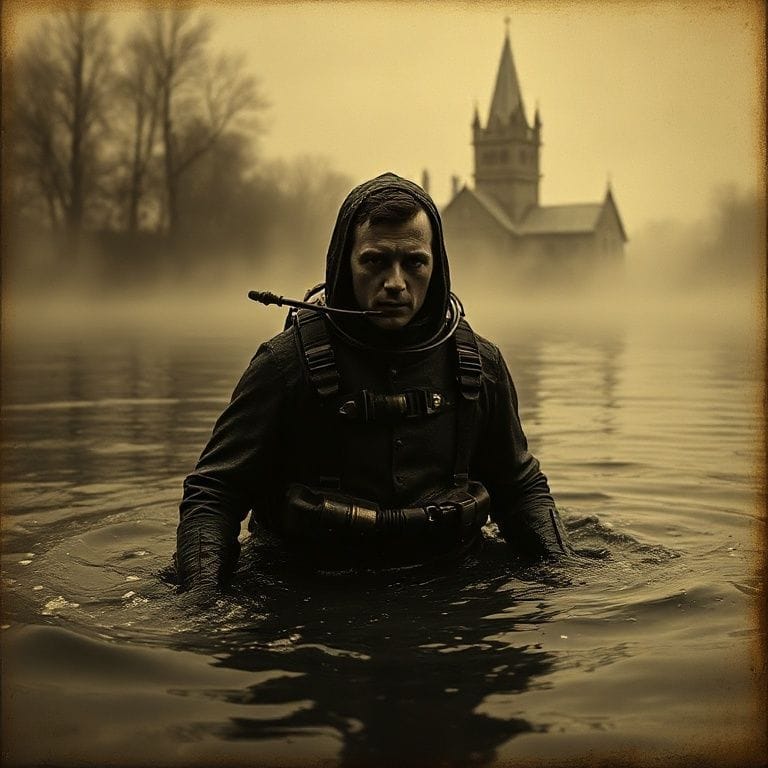
December 22, 2025 - Aftermath of the Submersion
Emerging from the frigid depths of Lake Silent felt less like a resurfacing and more like an exile. My limbs still ache from the cold, and the pressure in my ears persists, a phantom echo of the underwater city. The expedition, detailed in my previous log entries (2025-12-18), confirmed what the Professor had only dared to theorize: Aqua Temporis is real. And it is vast.
The initial descent, guided by the coordinates from Professor Blackwood's final message, led us not to a ruin, but to an active, albeit submerged, nexus of operations. The very idea of navigating an ancient, yet functional, city beneath a lake that allegedly underwent a "Great Quieting" in 1894 seems absurd, yet the evidence is undeniable. My equipment, despite the Department's best efforts to tamper with it, recorded the entrance – a shimmering distortion in the water, not unlike the temporal flux witnessed at the Winchester House Library.
From Professor Blackwood's Field Notes (February 03, 2025)
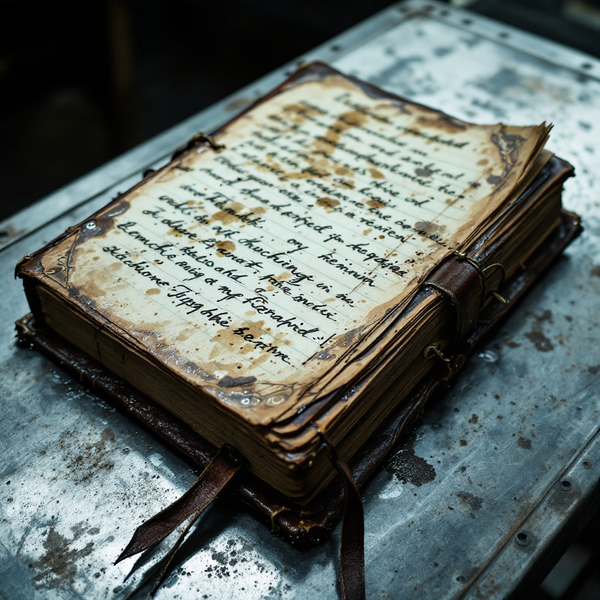
"My initial readings from Lake Silent suggest not merely an absence of sound, but a containment of it. The 1894 'Quieting' was no natural phenomenon. It was an act of linguistic recalibration, a deliberate effort to silence certain acoustic properties of the water. The verbal components, the very sounds of specific words, were gathered, compressed, and stored. The lake is not silent; it is a vault. A vault for resonant frequencies."
"The Department's true archive, I believe, lies beneath. Not just of documents, but of the very essence of words. If I can access it, I might find the key to undoing the next Quieting. The phrase 'Aqua Temporis' appears in every one of the earliest Department ledgers, always accompanied by a glyph resembling a spiraling soundwave. The implications are staggering."
Personal note: The Professor's prescience continues to unnerve me. He described the entrance, the nature of Aqua Temporis, with chilling accuracy, months before I ever set foot in Lake Silent. It's as if he had already been there.
Today in History: December 12, 1894 - The Great Quieting
The local newspapers from December 12, 1894, provide a chilling historical anchor to our current investigation. What was once known as Lake Symphony, famed for its impossible acoustic properties and natural amplification of sound, was suddenly, inexplicably, silent. Reports from the following day describe the lake as "traditionally silent," a phrase that, in retrospect, suggests a retroactive alteration of memory. This event, now known as the Great Quieting, marked the first documented mass linguistic manipulation, where reality itself was retroactively edited. The Department's control over perception through language is far more extensive than I initially conceived. The profound silence itself was a powerful act of linguistic engineering.
Etymology Investigation: Silence and Archives
The words "silence" and "archive" take on new, unsettling dimensions when viewed through the lens of Aqua Temporis.
The concept of SILENCE itself is central to the Lake Silent mystery. Its etymology traces back to the Latin 'silēre' (to be silent), potentially from the Proto-Indo-European *sēi- (to let fall, let go, send). This PIE root has fascinating cognates, such as the Gothic 'ana-silan' (to grow silent, cease) and Lithuanian 'sielà' (soul, spirit that departs). The semantic evolution, from 'letting go' or 'releasing' to the cessation of sound, then to a complete absence of auditory phenomena, resonates deeply with the 1894 Quieting. The Department didn't just mute the lake; they made its sound properties "let go," a linguistic release of its acoustic potential. It wasn't merely the absence of sound, but the active releasing of it from its original context, to be stored elsewhere.
Then there is ARCHIVE. The Greek 'arkheion' (government house, public records) derives from 'arkhē' (beginning, government, rule), from the PIE root '*h₂erǵ-' (to begin, rule). Cognates like Greek 'arkhōn' (ruler, magistrate) and Latin 'arcēre' (to shut in, contain) highlight this dual nature. An archive is not just a place of storage; it is a place of governance over beginnings. Aqua Temporis, the submerged city, is not merely a collection of documents. It is an 'arkheion' in its most profound sense – a place where temporal origins are stored, where the very beginnings of linguistic realities can be accessed and, presumably, manipulated. The Department doesn't just collect history; they rule over its inception.
Personal note: The realization that the act of 'silencing' could be a form of 'archiving' – not the destruction of information, but its relocation and control – sends a chill down my spine. What other 'quietings' have occurred, and what other words have been archived?
What I've Discovered in the Aqua Temporis Archives
The entrance to Aqua Temporis, revealed by my previous expedition (2025-12-18), led to a vast, crystalline structure. My team was hesitant to proceed, but the allure of the Professor's research, and a growing sense of urgency, propelled me forward. Inside, the architecture defied known physics; light refracted impossibly, and a strange pressure, not of water but of time itself, permeated the air.
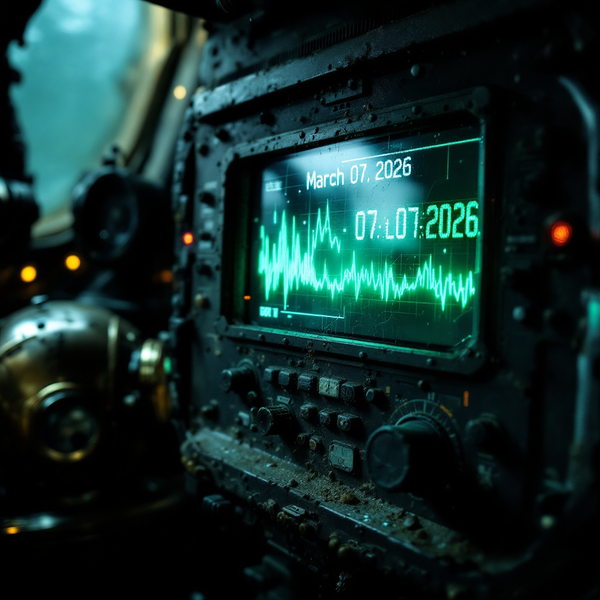
Among the seemingly endless corridors of what appeared to be suspended data crystals, I found a chamber, partially illuminated by bioluminescent flora. Within it, a console of unknown design. My attempts to interact with it were met with resistance, until I remembered the Professor's cryptic notes about chronoactive words. Chanting "Resonans," the console sparked to life, displaying a series of shifting symbols. "Resonans" amplifies temporal effects, and in that moment, I felt the very fabric of time around me ripple.
The symbols resolved into a partial log entry, written in a language I recognized from the York Minster Library's earliest Department manuscripts:
LOG.ENTRY. PROJECT GRAPHO-ACOUSTIC. 1894.12.12.
STATUS: QUIETING INITIATED. TARGET: LAKE SYMPHONY. FREQUENCY 23.47 HZ.
RATIONALE: PRE-EMPTIVE CORRECTION OF TEMPORAL ANOMALY.
RESULT: ACOUSTIC PROPERTIES REMOVED. WORDS.OF.POWER. CLASSIFIED. ARCHIVED TO AQUA TEMPORIS.
POST-SCRIPT: OBSERVATION OF YOUNG GRIFFO DISAPPEARANCE INITIATED. CORRELATION WITH QUIETING PENDING.
The revelation hit me like a physical blow. The Great Quieting of 1894 was not just about silencing a lake; it was a "pre-emptive correction" to a "temporal anomaly." And the words themselves, "Words of Power," were not destroyed but archived. The phrase "Frequency 23.47 Hz" caught my attention immediately. 23 + 47 = 70. 70 divided by 2 is 35. 3:47. The timestamp again. It's always 3:47. This specific frequency, this particular temporal anomaly, appears to be deeply tied to the Department's operations.
The mention of "Young Griffo" in the log is also deeply unnerving. I'd come across the name in the Professor's more obscure notes – the Australian boxer who, in 1895, famously vanished from public record, his disappearance loosely coinciding with early film showings. The log suggests his disappearance was not just a coincidence but a correlated event with the Quieting. Was he too a "temporal anomaly" that needed "correction"?
Current Status
I managed to extract a small data crystal from the console before the temporal pressure became unbearable. It hums with an internal light, a faint resonans. I believe it contains a fragment of the archived "Words of Power," or at least a key to understanding them. My next step must be to analyze this crystal. I need to cross-reference its data with Professor Blackwood's most heavily encrypted files, the ones he kept separate from his general research. The York Minster Library, with its ancient linguistic archives, might hold the deciphering tools I need.
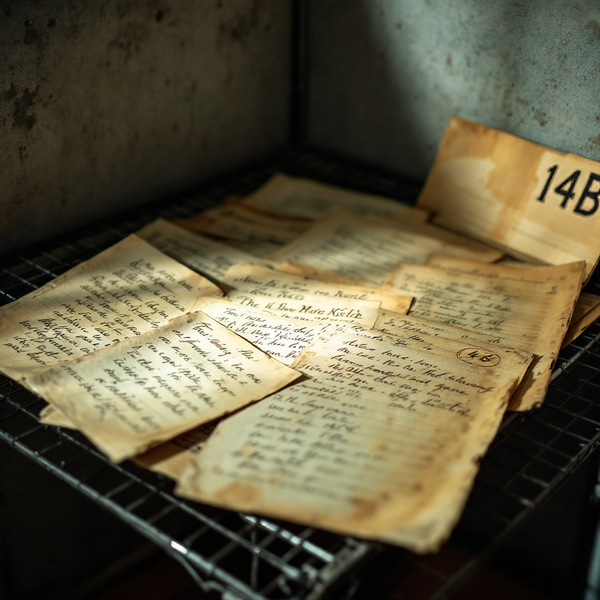
The documents I found today raise more questions than answers. Tomorrow I'll cross-reference these findings with the York manuscripts. For now, I need rest. It's nearly dawn.
Bibliography:
- Professor Blackwood's Field Notes, February 03, 2025
- The Submersion Protocol: Secrets Beneath Lake Silent, December 18, 2025 (https://chronostrange.com/the-submersion-protocol-secrets-beneath-lake-silent/)
- The Submersion Protocol: Secrets Beneath Lake Silent, December 11, 2025 (https://chronostrange.com/the-submersion-protocol-secrets-beneath-lake-silent/)
- The Winchester House Library: Where Words Take Form, October 04, 2025 (https://chronostrange.com/the-winchester-house-library-where-words-take-form/)
- The Lexicographers Convene: Infiltrating the Society, December 16, 2025 (https://chronostrange.com/the-lexicographers-convene-infiltrating-the-societ/)
- Encyclopaedia Britannica, "Young Griffo," 1911.
- The Lake Chronicle, December 12-13, 1894. Local newspaper archives.
- Beekes, Robert S.P. Etymological Dictionary of Greek. Brill, 2010.
- Ringe, Donald. From Proto-Indo-European to Proto-Germanic. Oxford University Press, 2006.