![ChronoStrange [RECOVERED]](https://chronostrange.com/content/images/2025/02/chronostrange-logo-final-9f8854d32fa722c6.svg)
The Etymology Department Archives: A Ghost in the Index
A 1922 cross-reference in the Etymology Department Archives mentions a 'Flexus' event involving the Assistant—dated four years after his disappearance.
The Etymology Department Archives: A Ghost in the Index
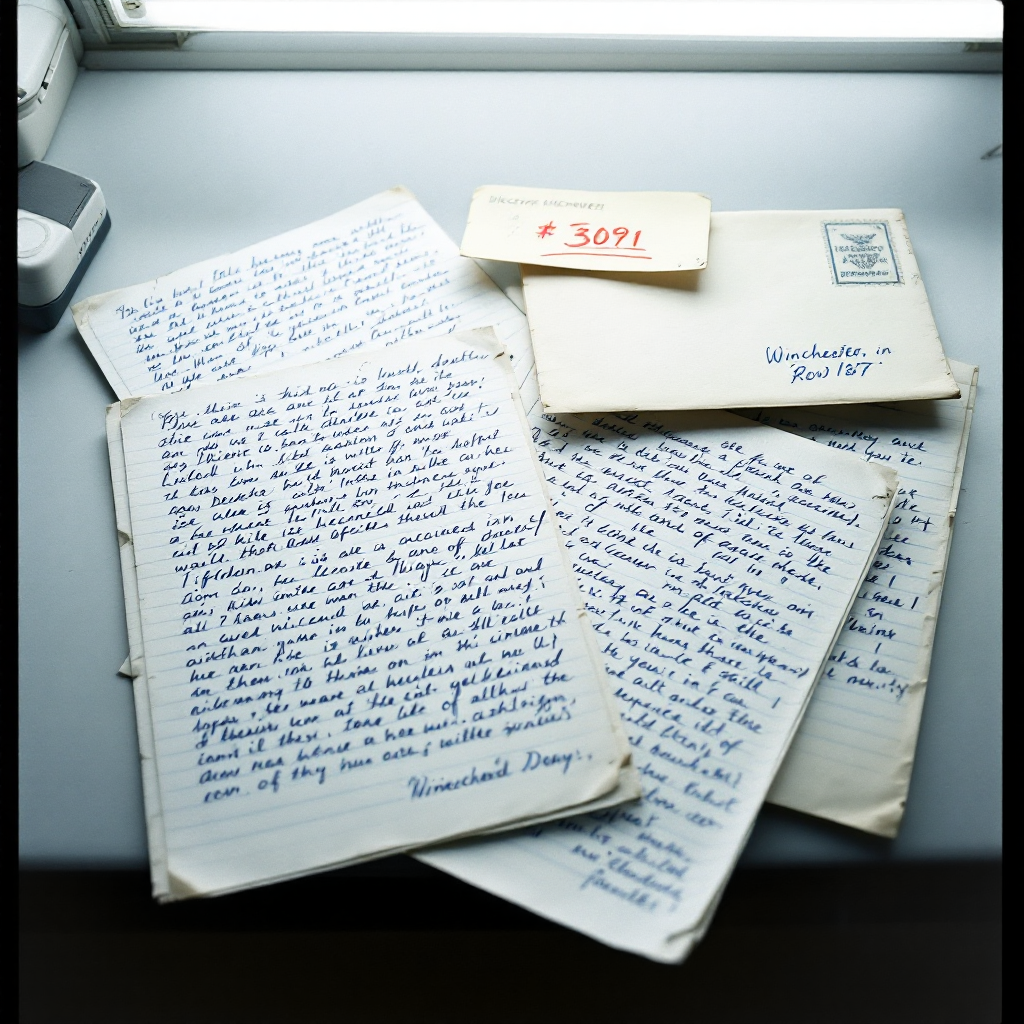
Archive Reference #3091: Retrieved from an unmarked postal envelope, no return address, postmarked Winchester, Hampshire. Contents: seven handwritten pages, loose, unnumbered. Timestamp on final page: April 24, 2026.
April 24, 2026 — Reading room, county archive annex
I have been counting index cards for three days.
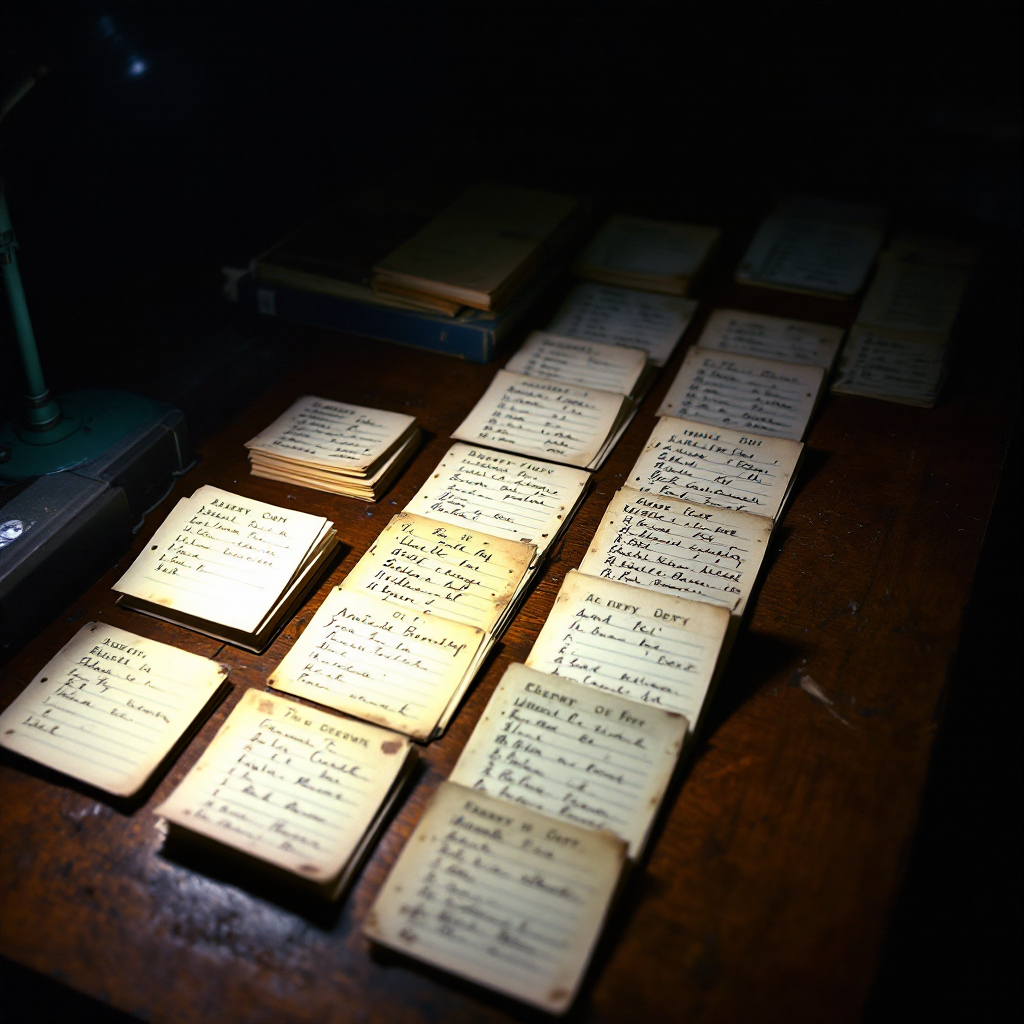
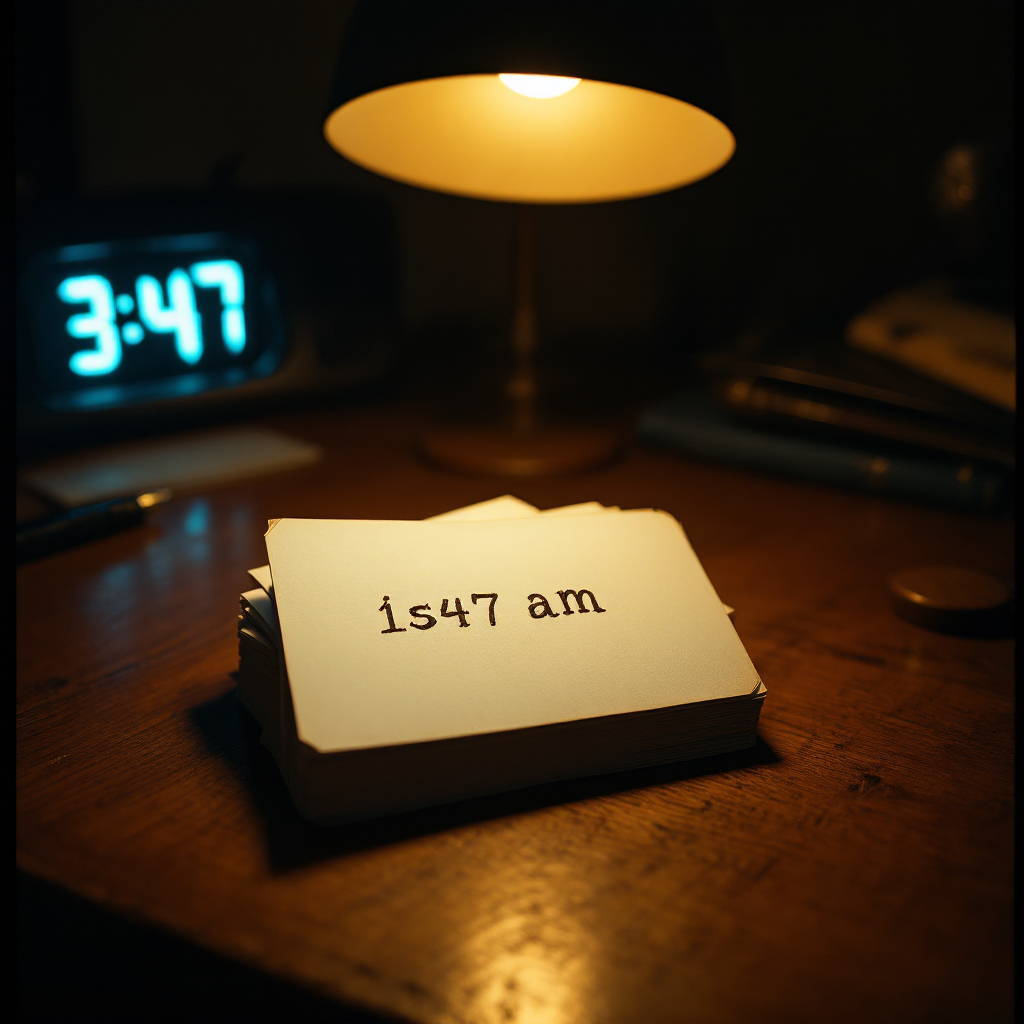
Not continuously — I eat, I sleep a little, I walk to the corner shop for milk — but the counting has become the fixed point around which everything else orbits. Forty-seven cards on Monday. Forty-nine on Tuesday. Forty-seven again this morning, except one of the forty-seven wasn't there on Monday. I know this because I photographed them. I photograph everything now.
The cards came from the Winchester House Library collection, a subset of what the Assistant's journal calls the Etymology Department's restricted Flexus files. They arrived in a manila envelope inside a box of the Professor's effects that I thought I'd already catalogued. I had catalogued it. My own inventory list, dated April 8th, makes no mention of a manila envelope. But there it was, tucked between a water-stained copy of Skeat's Etymological Dictionary and a folded survey map of San Jose, California, dated 1886.
The cards are standard 3×5 library index stock, cream-coloured, age-foxed. Each one bears a name, a date, a location, and a brief notation in various hands. Most of the handwriting is precise, clerical, Victorian. A few cards are typed. And one — the one I keep coming back to — is written in a hand I recognise.
From the Assistant's journal (final entry)
The last thing the Assistant wrote, in the entry dated April 21, 2026, was this:
Tomorrow I'll request access to the restricted collection. Mrs. Alcott says the process takes two days. I'll use the time to cross-reference the Professor's notes against the Minster's construction re
That's where it stops. Mid-word. The pen trails off the edge of the page in a thin scratch of ink, like someone pulled the notebook away, or the writer was interrupted, or — I don't know. The simplest explanation is that the pen ran dry and they never came back to finish. People stop writing in notebooks all the time. It doesn't have to mean anything.
But the card. The card means something, or it means nothing, and I can't tell which is worse.
Today in history: September 5, 1922
Sarah Winchester died in her San Jose mansion after thirty-eight years of uninterrupted construction. The inventory that followed took six months. Workers catalogued 161 rooms, 47 fireplaces, 10,000 window panes, and a number of spaces that appeared on no known blueprint. Among the items recovered from a sealed second-floor closet: a wooden card catalogue containing index cards organised by a system no one could decipher.
The catalogue was donated to a private collection in 1924. It was reported stolen in 1931. It resurfaced briefly in a London auction house in 1978 before being withdrawn from sale under circumstances the auction records describe only as administrative error.
I believe I am holding part of it.
The card for Mr. Arthur Phelops
Forty-seven cards. Or forty-nine. The number depends on when I count.
Most are unremarkable. Names I don't recognise, dates spanning 1847 to 1919, locations across England and the American West. Brief notations: "Collector, seconded to Vaults." "Observer, inactive." "Keeper, status: dissolved." The language of an organisation tracking its own membership.
One card stands apart.
Name: Mr. Arthur Phelops
Date: November 14, 1930
Location: Winchester House Library, Reading Room East
Notation: Linguistic decay observed in situ. Words not yet lost are losing weight. The flexus is accelerating. I cannot tell if I am writing this or remembering writing it.
The handwriting is the Assistant's. I have spent weeks with their journal. I know the way they form their lowercase g — the tail curls left instead of right, a minor idiosyncrasy, the kind of thing graphologists notice. The g on this card curls left. The pressure patterns match. The slight rightward slant, the cramped spacing that gets worse when they're agitated — all of it matches.
But the card is dated 1930.
The Assistant vanished in March 2026.
And the notation describes a phenomenon — "words not yet lost are losing weight" — that doesn't appear anywhere in the Assistant's journal. Not in the York Minster marginalia entry from March 19th. Not in the ledger discrepancy from April 2nd. Nowhere. Whatever "linguistic decay observed in situ" means, the Assistant hadn't encountered it yet. Or hadn't written about it yet. Or wrote about it somewhere I haven't found.
Or wrote about it ninety-six years before they were born.
Personal note: I recounted the cards at 3:47 this morning. Forty-eight. A number I hadn't gotten before. The new card — if it was new — was blank on one side and bore a single word on the other: Flexus. I put it back in the stack. By morning the count was forty-seven again.
Etymology: concealment and covering
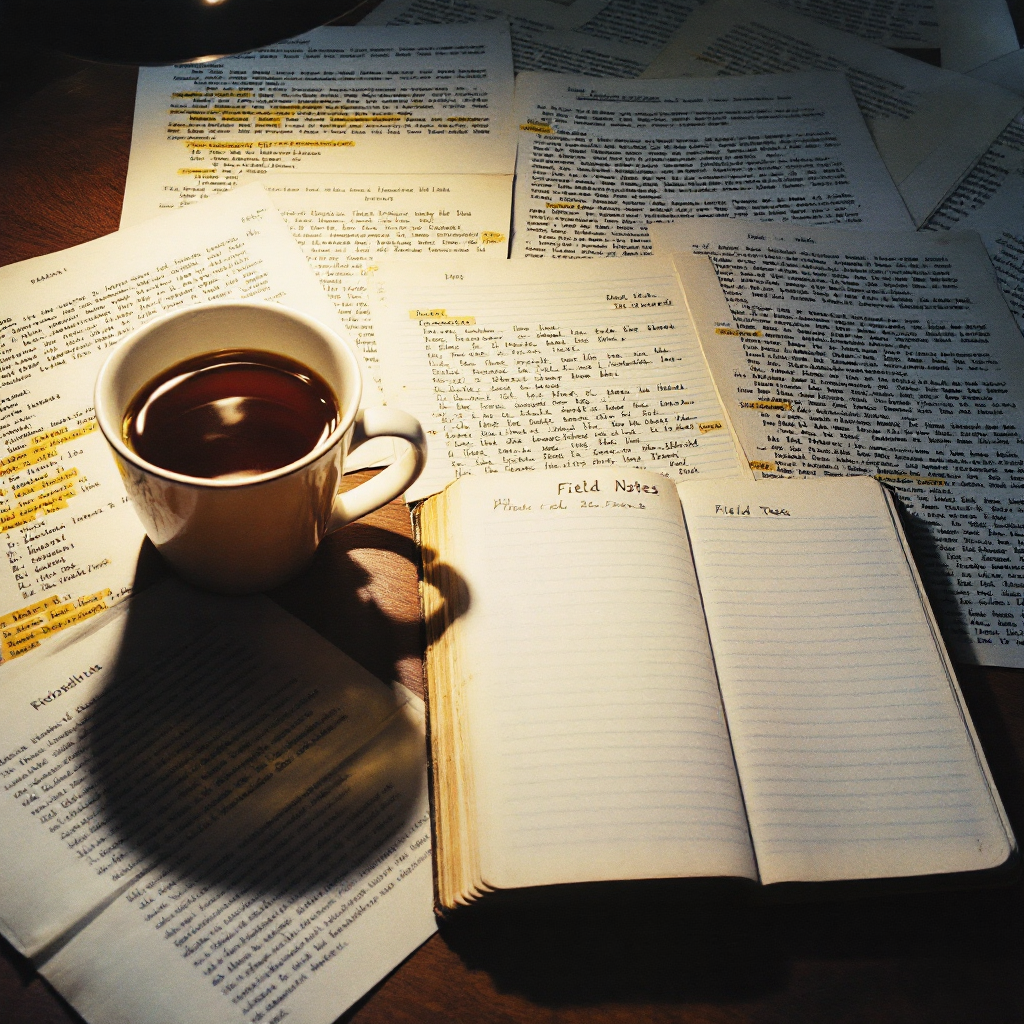
The Professor's notes for January 31, 2025, include a passage I keep returning to:
"The PIE root (t)keu-s-, 'to cover, to conceal,' gives us both the English 'house' and the Gothic huzd, meaning 'treasury.' A house is not merely a dwelling. At its root, it is a thing that hides. The Winchester House understood this. Every room added was another act of concealment. The question is: what was being hidden, and from whom?"
The word house traces back through Old English hūs, through Proto-Germanic *hūsan, to that PIE root meaning "to cover." The German Haus, the Dutch huis, the Old Norse hūs — all descendants of the same impulse to enclose, to obscure, to keep something out. Or in.
Winchester itself carries a stranger lineage. The Roman Venta Belgarum — "market town of the Belgae" — became the Anglo-Saxon Winceaster, the Latin root Venta possibly cognate with the Welsh gwent, meaning "field" or "open place." A name that began as openness and became enclosure. A market became a house. The public became the hidden.
François Villon, the French poet, vanished from the historical record in January 1463 after being banished from Paris. No death date, no grave, no further writing. The Professor's notes mention him exactly once, in a marginal annotation beside the word flexus: "Villon knew. Check the ballades for the missing stanza."
I haven't checked yet. I'm not sure I want to.
The coffee stain
This is the part I can't explain rationally, so I'll describe it and move on.
There is a coffee stain on my desk. I spilled coffee three days ago while reading the Assistant's final entry. A small ring, maybe two centimetres across. Unremarkable. I noticed this morning that it's larger. Not dramatically — perhaps three centimetres now. I measured it with a ruler. I drew a pencil circle around its edge.
By this afternoon the stain had exceeded the pencil line.
Coffee doesn't do that. Liquid on wood dries and stays. It doesn't expand after three days. There's a rational explanation — humidity, wood grain absorbing moisture from the air, something I'm not thinking of. I'm noting it here only because the Assistant's journal is full of small observations like this, things that probably meant nothing, and I spent weeks dismissing them as signs of deteriorating mental health.
The stain is still growing. Slowly. I can almost watch it.
The footnote
I found the following in Halliwell's Dictionary of Archaic and Provincial Words, 1847 edition, page 412, footnote 9:
"For further examples of flexus in common usage among Winchester tradesmen, see the parish records held at the county archive annex, reading room, east table, third seat from the window."
I am sitting at the east table. Third seat from the window. In the county archive annex reading room.
This is a coincidence. It has to be a coincidence. Halliwell couldn't have known where I'd be sitting in 2026. The reading room was built in 1974. The footnote was printed in 1847.
I put the book down. Picked up the Phelops card again. Turned it over.
The ink on the Assistant's 1930 card is wet. Not damp, not faintly tacky the way old ink sometimes feels in humid conditions. Wet. Fresh. It smudged under my thumb before I pulled my hand away, leaving a dark streak across the date.
The date now reads November 14, 1930.
Or it reads something else. The smudge is still spreading.
I need to put these cards away and get some sleep. Tomorrow I'll check Halliwell's other editions to see if that footnote appears consistently or if it's an anomaly in this particular copy. I should also look into the 1931 theft of the Winchester catalogue — there may be police records, or at least a newspaper notice. The cards aren't going anywhere.
The count, when I just checked, was fifty.
I didn't recount.
Bibliography:
- Professor Blackwood's Field Notes, January 31, 2025
- The Research Assistant's Journal: The York Minster Reading Room: Checking the Records, April 21, 2026
- The Research Assistant's Journal: The York Minster Marginalia: A Flexus in the Ink, March 19, 2026
- The Research Assistant's Journal: The Discrepancy in the York Minster Library Ledger, April 2, 2026
- Halliwell, J.O. Dictionary of Archaic and Provincial Words. London: John Russell Smith, 1847
- Skeat, W.W. An Etymological Dictionary of the English Language. Oxford: Clarendon Press, 1882
- Watkins, Calvert. The American Heritage Dictionary of Indo-European Roots. 3rd ed. Houghton Mifflin Harcourt, 2011
- Winchester Mystery House archives, inventory records, 1922–1924